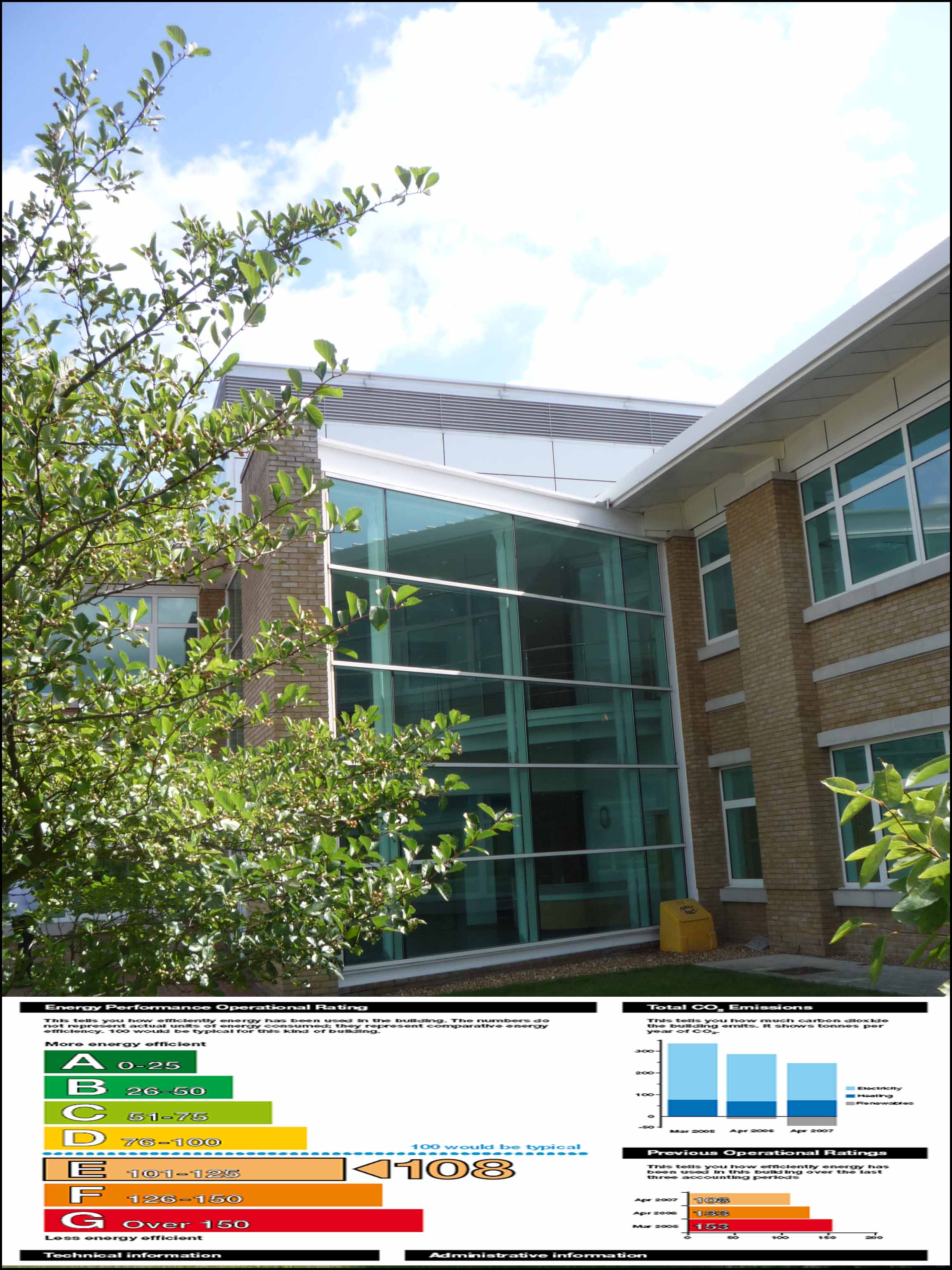
What is a Display Energy Certificate?
A Display Energy Certificate (DEC) is required for buildings
which are in excess of 1000 m2 and occupied by either a Public Authority or an Institution providing
a public service and visited by the public.
The
legislation came into force since 1 October 2008 according to EPBD.
A DEC shows the energy performance of a
building based on its actual annual energy consumption and the CO2 emissions that result
from that energy use.
This is shown as a rating from A to G, where A has the lowest CO2 emissions (best) and G the highest CO2
emissions (worst).
The rating is also shown as a number. A typical building of its type would have a rating of
100. A building with twice the typical CO2 emissions would
have a rating of 200.
A DEC must be accompanied by an Advisory Report containing recommendations for
improvement of the energy performance of the building.
A DEC must be placed in a prominent place clearly visible to the public. It's
recommended the certificate should be no smaller than A3 size.
How long is a DEC valid for?
A DEC is valid only 1 year and must be renewed
every 12 months ,but the Advisory Report is valid for 7 years.
What factors would contribute to a DEC rating?
- Building Category
- Location
- Energy Consumption
- Building
Gross Internal Area (aka Total Useful Floor Area)
- Separable
Energy Use
- Occupancy
What is the penalty for not having a DEC?
A local authority can issue a penalty charge notice of £500 for failing to display a DEC at all times in a
prominent place clearly visible to the public, and £1,000 for failing to possess or have in their control a valid advisory
report.